Saturday, October 20, 2007

Picking out the best-sellers

Everyone knows whether he or she likes a book, or not, after reading it. DAPHNE LEE finds out how book merchandisers figure out which titles you’ll like before reading them.

YOU can’t judge a book by its cover. But some do. While the prettiest jacket will not disguise a badly-written book, there’s no denying that a customer with nothing particular in mind, browsing indiscriminately in a bookstore and faced with hundreds of books, might well choose the one with the most attractive cover.

Book merchandisers know this and, therefore, the look of a book is something they do notice when ordering new titles.

Seto Kit Sau, who is unit chief of the Kinokuniya Bookstore's children’s fiction department says, “Yes, I like to choose nice covers, but they also have to have good content.”

She names Into the Forest by Anthony Browne as a prime example of a book with an intriguing cover “and a very cool story to boot.”

Children’s book merchandisers agree that children are attracted to colourful covers and parents, too, are often similarly influenced.

The book cover and design do play a pivotal role in determining its popularity and saleability,” says Samantha Tang, merchandising manager at Popular Book Co.

She says that the first impression is very important and, for busy parents, it may be the only thing that leads to a purchase.

“Most of the time, parents don’t know where to start looking and, if they are not interested in browsing through the book themselves, then the cover is the only thing they have to go by.”

That’s where the merchandiser comes in. He or she has to ensure that, as far as possible, a book’s content lives up to its appearance.

For Kinokuniya's merchandisers, all avid readers themselves, the books they choose must pass the “first paragraph” test.

Teressa Hoon, unit chief of Kinokuniya's literature and general fiction sections, explains: “The first paragraph has to grip you immediately. It must make you want to read more. Even better, it must make you reluctant to put the book down.”

An interesting title is also a plus as it can prompt one to take a book off the shelf in the first place (without which there can be no reading of the first paragraph).

Kinokuniya's non-fiction merchandiser, Yong Jet Yau, picked Rory Stewart's The Places in Between because of its “intriguing title” as well as subject matter: the author's account of his walk across northern Afghanistan shortly after the fall of the Taliban.

Shortly after Kinokuniya started selling the book, it entered the New York Times best-sellers list.

Kinokuniya included it in their Gem of the Month promotion last month and it sold out.

“It's great when a book you believe in sells well,” says Yong. “It makes me feel like I'm on the right track.”

Like her colleagues, she likes the task of introducing customers to books that are new, interesting and surprising.

Says the merchandising manager of the store, Abby Wong, “Informed buying is our ultimate objective. We should know our product and we shouldn't underestimate the intelligence of our consumers.

“Book buyers can start trends by exposing Malaysians to new titles. You often hear customers mention the same old business books, the same old self-help or science books, but there really is so much more out there.”

Yes, there is, but among the many good reads, dross sometimes lurks – and sometimes it ends up on the shelves anyway, thanks to popular demand.

Says Seto, “Sometimes market demands compel us to order books that are not well written. Sometimes, they are popular because they are associated with a hit movie or TV show.”

Although these are books that Seto, if she had her way, would like to keep off the shelves, a merchandiser is required to keep an open mind and not be swayed by personal taste.

“Our likes and dislikes definitely influence our decisions, but we have to be careful not to get too carried away by our own tastes,” says Yvonne Chau, the MPH Bookstores merchandising manager for general books, a department that includes cookery and self-help titles.

Ultimately, bookstores are businesses and the bottom line is to make a profit.

So, as Tang puts it, “We have to try to be conscious of the fact that what we prefer might not be what the public wants.”

What the public wants, apparently, are bestsellers by the likes of Dan Brown, John Grisham and Sophie Kinsella, feng shui books by Joey Yap and Lilian Too, and self-help manuals.

This is why merchandisers must take heed of international bestsellers lists and the latest efforts of tried-and-tested authors.

Hoon says, “Naturally, I will order more copies of a book by A-list authors like Michael Connelly, Mitch Alborn and Kazuo Ishiguro.”

For chains like MPH Bookstores and Times the Bookshop, there is the added complication of differing demands depending on the outlet.


“For example, business books are very popular at our store in Suria KLCC so there is a larger Business section there,” says Wong Yuen Poh, Times' retail manager.

“But, at Bangsar Shopping Centre (in Kuala Lumpur), general fiction titles are more in demand because that is a residential area. We try our best to track the sales in the different outlets to determine the needs of the customers,” she says.

Says Chau, “We take note of the area, the sort of customers and their spending power, and taste in reading material, but sometimes trends change.

“Ten years ago, Malay fiction sold best at the store in Alpha Angle (in Petaling Jaya, Selangor), but English titles are gaining in popularity now.”

“Malaysian authors like Tash Aw (author of the The Harmony Silk Factory) tend to be popular in all the stores,” adds Ramji. “And Devika Bai (The Flight of the Swans) is especially popular in Johor Baru because that was where she lived.”

Malay romance novels are also extremely popular, along with religious books.

Over the last five to 10 years, says Ramji Rabi, MPH’s assistant merchandising manager for the fiction department, Malaysians have increasingly paid more attention to literary award winners.

However, not all winners are hits with Malaysians. Two titles that have been a great success here are Life of Pi by Yann Martell and The God of Small Things by Arundhati Roy.

What makes the real difference is media attention,” says Wong. “Customers will ask for books that are highlighted by newspapers.”

All the merchandisers we spoke with make it a point to read or at least research what they are choosing for the stores.

“It makes sense to know what we are selling,” says Tang, who says that when time constraints do not allow her to read a book from cover to cover, she then reads reviews in trade magazines and online bookstores, compares sales reports of books in the same genre and seeks the distributors' advice.

“An interest in reading is an asset in this job,” she says. “Thousands of new books are published every year and we must be able to cherry pick titles suitable for our local market.”

Saturday, October 13, 2007

SELECTION OF PAPER

We have decided to go with off-white recycled paper instead of virgin white paper for the publishing of my book.

Recycled off-white paper are more expensive than virgin pure-white paper, but it saves the trees and the yellowish tint means it's less strenuous for the readers to read.

Wednesday, October 10, 2007

The Publishing Process

At first my publisher wanted to do away with the cover flaps, because he wanted to give the book a “novel-like” look. (Flaps are like “wings” of the book cover, and extension which allows extra information such as the story synopsis, or author’s profile to be included) But I disagreed with him. I felt that cover flaps can help to make the book look more sturdy, and make it look more like a “hard-cover” book.

The flaps also help prevent the book cover from being crumpled/dog-eared. In addition for cover flaps, I also requested for the first and last page of the book to be made of red art paper. I feel this will enhance the “quality feel” of the book, and thus increase its perceived value.

Even if all 1,000 copies of the first print-run were sold, we’d only get to break even. The chance of making a loss on this publication is very high. So why do we still go ahead and publish the book? Because the profit would come from the larger print volume (based on economies of scale) on subsequent prints.

I’d like you to give me your support. If you like the book after browsing through it at the bookstore, do buy it. It helps the writer (me!!! ^^) place food on the table.

Thank you. ☺

Friday, October 5, 2007

Book Cover Design

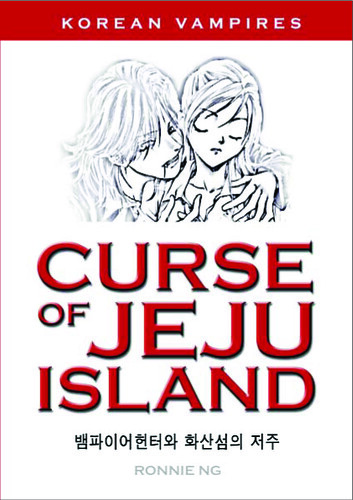
When my publisher (Candid Creation) sent me the cover art for my debut fiction, Curse of Jeju Island, I liked it very much. The colours red, white and black fit with the theme. Here's what they've done so far:


This cover is actually a result of emails that went to and fro between my publisher and I. Yes, there should be mutual respect and exchange of ideas and information between the writer and his publisher. After much discussion on the colour theme, illustration, and selection of font, the result is a design which I'm very satisfied with.


Thursday, October 4, 2007

THE ART OF STORY TEASING

Apart from the cover design and the author’s name, the story synopsis may be the most powerful sales tool for your book, the final thing that clinches the deal in the reader’s mind and makes him/her carry that book to the cash register. Here’s what will appear on the back cover of CURSE OF JEJU ISLAND:

Over fifty years ago, 60,000 people were killed during the 'Jeju Massacre' on Jeju island, South Korea, when the South Korean Army attempted to brutally suppress an armed insurrection by the people of Jeju.

The bodies of the victims - civilians,rebels, and soldiers alike - were sealed in a volcanic cave on Mount Halla to rest, or so it was hoped, in peace for all eternity.

However, decades later, some of these bodies were mysteriously resurrected as vampires and they are now doomed to roam the streets of Jeju seeking living human prey and continuing the battles that they once fought in life. Thus, the bitter feud between two mortal factions - The Regiments (former soldiers) and The Guerrillas (formal rebels) - has now become immortal.

Today, fifty years later, we meet Han Mirae, a young Korean girl who is caught in a love triangle between Jackie Chang, a swashbuckling vampire hunter from Singapore, and Shin Taewoo, a powerful vampire of the Guerrillas. And, we meet Lee Hyunsuk, the opal-eyed vampire of the Regiments, who abducts Mirae in order to set a trap to kill the other two.

Can Taewoo or Jackie save the girl in time? And who is Mirae's real love?

Saturday, September 29, 2007

Korean Meets Singaporean: Funny Dialogues

HY (i shan't reveal her real name) is my friend who's a Korean flight attendant with SIA. When she first started her job as a trainee crew, there were some funny incidents which happened because of her grasp of English.. Please don't take it that i'm trying to ridicule the Koreans but rather look at it that i'm just sharing some thing here with everyone just for a good laugh, ok?


Incident One - Keopi of Straits Times

============================
Flight Passenger: Can i have a copy of Straits Times please?

HY: (thinking to herself: "Keopi" and Straits Times?)
*in Korean, "Keopi"(커피) means "Coffee"

Shortly after, HY returns with the customer's request.

HY: Sir, here is your Keopi and Straits Times.

Flight Passenger: (looking puzzled) Did I ask for coffee?

Incident Two - Catch up in Your Work
===============================
Flight Supervisor:
HY, i think you should try to catch up in your work.

HY left abruptly and returned shortly with a sachet in her hand.

HY:
You asked for Ketchup?

---------------

i also personally experienced such incidents 3 years ago
when i had my first brush with Korean people. At that time,
i haven't started learning Korean & a few Koreans didn't have
a good grasp of English either..Anyway, here goes:

Incident Three - So Far?
=================
i was having a conversation with a Korean executive.

Me:
So, how's your job getting so far?
(it's supposed to mean: is it getting interesting, tough, boring?, etc)

Executive:
So far? No, not far.. near my house..


Incident Four - How I Found It

=======================
i was having a conversation with a Korean secretary.

Me:
So, how do you find your job?
(it's supposed to mean: is it interesting, is it tough, boring?, etc)

Secretary:
Oh, i found it from the newspapers...


Incident Five - I am Fine, Thank You
==========================
i was still talking with the same Korean secretary.


Me: Oh, i see.. how old are you, by the way?

Secretary: I am fine, thank you.

Friday, September 28, 2007

巫侠小说 CHINESE WIZARDS

Excerpt:

Ancient China During 1115 BC

It was a dark time in the magical lands of ancient China, known as the Central Realm (中原). The Jurchen army of Jin Kingdom (金国) collaborated with the evil clan of “Xiemo” (邪魔圣教) and overthrew the Liao Kingdom (辽国). The Jurchen are one of the Non-Chinese nomad peoples that inhabited the area of modern Manchuria in China's northeast. Having conquered the Liao Kingdom, the king of Jin, Wanyan Aguda (完颜 阿骨打) then proclaimed himself emperor of the Jin Empire. To thank the Xiemo clan for his support, Wanyan Aguda declared the clan’s leader, Lord Mozun (魔尊), as the Prime Minister. All the members of Xiemo clan, known as Moguizi (魔鬼子), rose in power and became the evil military police of the new kingdom.

The people of the former Liao Kingdom lived in terror as they were violently oppressed by Moguizi on a daily basis. Everyday there were rumours of villages that had been destroyed or people being tortured to death simply for their oppressors’ entertainment. Freedom had simply ceased to exist the day the Liao Kingdom was conquered.

The neighbouring Chinese people of the Song Empire (宋朝) were still holding out in the war against the Jurchen and Moguizi. The Jurchen had already captured Northern Song (北宋), and it would only be a matter of time before Southern Song (南宋), too, would fall. The fall of the Liao Kingdom had changed the balance of power, and it was obvious that the entire Central Realm would eventually be swallowed by the Jin Empire as eventually.

At the same time, there lived a community of highly skilled Chinese wizards known as Wuxia(巫侠).’Wu’ means anything related to witchcraft and wizardry, while ‘Xia’ refers to a chivalrous and righteous person. Thus ‘Wuxia’ refers to a righteous person who excels in wizarding kungfu (巫灵功夫) and who uses their magical expertise to protect the innocent and right social unfairness or injustice (鋤強扶弱). Such a person is said to possess ‘magical virtue’ (巫德), and usually regarded as a people’s champion. The wizarding community was made up of several clans, and the two most prominent of them all was the Wudang clan (巫当派) and Shaoling clan (少灵派).

This story begins with a 16 year girl who lived in the Yang Village (杨家村) near the Northeastern borderlands of the former Liao kingdom. Her name was Shangguan Lingxue (上官灵雪), and she was the daughter of a village physician (a.k.a. healer).

It was mid summer, and Lingxue had ventured into the woods to gather some herbs for her father. The girl hadn’t been lucky however, and before she knew it, it was quite late. ‘I should really get back to the village before it gets too dark.’ she sighed.

However, she noticed something was wrong when she was still a distance away from the edge of the woods; there was a reddish glow in the night sky, toward the vicinity of the village. Fearing the worse, Lingxue hurried toward the edge of the woods. When she finally got there, she gasped.

The village was under attack! Straw and wooden huts were on fire and Moguizi were running all over the place along with dark creatures that appeared to be under their control! Ogres, minotaurs, goblins, werewolves (collectively known as ‘demons’ or ‘妖魔’) were tearing down buildings and killing every living thing in sight that was not a Moguizi or a demon! Lingxue stared in shock as she saw many people he knew personally being murdered right before her very eyes! Then, before anyone saw her, she turned around and ran! Lingxue ran as fast as her legs could carry her away from the massacre: away from the only life that she knew that had been taken from her in one attack.

Eventually, Lingxue grew exhausted and collapsed under a willow tree (柳树). As she sat there, the reality of what she had just witnessed settled in, and she burst into tears. ‘My family is dead,’ she thought. ‘My friends, my home, my whole life is gone. What more can possibly happen?’ At this, she started crying even harder. It was only after her tears had subsided a little when she noticed a large shadow falling over her. Slowly, Lingxue looked up into the face of one of the minotaurs (黑牛魔) from the village. These black minotaurs were known as Heiniumo in the Central Realm.

The Heiniumo was twelve feet tall, had ebon skin, had a pair of sharp-looking onyx horns, and was carrying a large wooden club. Lingxue was too paralyzed with fear to even scream as the heiniumo grabbed her by the waist and hoisted her up. “No....please....” was all she could say as more tears flowed down her cheeks. She anticipated the worse as the heiniumo slowly started lumbering back towards the village, carrying the sobbing girl in its hand.

It was then that it happened. A young Wuxia (巫侠) was riding a divine condor (神雕), and he jumped out in front of the heiniumo, startling both the heiniumo and Lingxue. The condor had ivory-coloured feathers, and was striding in big steps with its two extremely thick legs. From the way it walked, with its head held high, the white condor certainly showed great power and grandeur.

The Wuxia, too, was a magnificent sight to behold. He was about Lingxue’s age and was quite tall and handsome. He was dressed in blue tunic, and clad in black boots. From beneath his shoulder coverings flowed a brilliant red cape and in his right hand he carried a silver sword with beautiful inscriptions adorning the blade. The winds were combing through his raven black hair, but the most striking aspects of the Wuxia were his thick brooding eyebrows.

“Put the girl down,” the Wuxia ordered.

At first, the heiniumo simply stared at the Wuxia. Then, without warning, the heiniumo let out a huge growl and swung its club toward the Wuxia! There was a sound of metal hitting wood as the Wuxia blocked the club with his sword. He then sent his condor jumping behind the heiniumo. The heiniumo turned around and swung his club again, only to have it once again deflected by the sword. Angrily, the heiniumo swung the club down with the all the strength he could muster! This time, the Wuxia had his horse jump out of the way as the club came crashing down.

All of a sudden, the Wuxia wielded his sword at the heiniumo and shouted “降妖剑法!” (“Xiangyao Jianfa” means “Demon-subduing Swordplay”)

Lingxue’s eyes widened as a red light shot out of the sword and hit the heiniumo, sending its club flying out of its hand into a shrub about ten feet away. The heiniumo looked confused as the Wuxia next shouted ‘乾坤魔移!’ (“Qiankun Moyi” means “Magical Maneuver of Qiankun”)

Lingxue screamed as she was mystically flown out of the heiniumo’s grasp and went drifting through the air. A second afterwards, she found herself in the arms of the Wuxia. The Wuxia shouted ‘魂飞魄散!’ causing the heiniumo to fall unconscious. (“Hunfei Posan” means “Broken Spirit, Scattered Soul”) Lingxue looked into the brilliant eyes of her rescuer and promptly fainted.

With Lingxue and the rider on its back, the condor fluttered its wings and flew toward a tall mountain. Green and luxuriant, the forest was thick, this mountain was called Mount Wudang (巫当山).

A huge towering mansion stood on the peak of Mount Wudang with a tall flagpole on either side of its gate. The flagpoles were about thirty feet tall, each with a huge red banner streaming in the wind. The banner on the left was embroidered in yellow silk, bearing the image of a majestic dragon. As the banner fluttered back and forth in the wind, the dragon seemed as though it had come alive and were about to jump down at any time. Just above the dragon’s head was a pair of bats, embroidered in black silk, waving their wings in flying motion. The banner on the right bore two huge Chinese characters in black that read “WU DANG,” all written in a bold, vigorous calligraphy.

Xxxxxxxxxxxxxxxxxxxxx

Spring was always a relaxing time of the year on Mount Wudang. The breeze gently brushed the willow trees and wild flowers, causing the air to be filled with the pleasant scent of the season.

When Lingxue woke up, the first thing she saw was a pair of twinkling eyes gazing at her. As her vision came in focus, she saw that they belonged to a kind looking bearded old man dressed in a Taoist tunic (道袍). He was standing in front of a wall with a swirling black and white emblem, known as “Taichi” (太极).

"Ah, I see that you have woken, Lingxue Guniang." (Guniang means “young lady” or “miss” in Chinese)

Lingxue looked around. She was lying on a bed in the middle of a small room with stone-brick walls. Sunlight was streaming through the windows behind her and there was a wooden door not far away from her bed. The old man was sitting on a stool right next to the bed.

Lingxue stared at the old man in bewilderment. "Wh-who are you? Where am I? H-how do you know my n-name?"

The old man chuckled and stroke his beard. "Ah, yes. In answer to your first question, my name is Taiji Xuanfeng (太极玄丰). I’m the founder of Wudang Clan (巫当派) and also the clan’s Grandmaster. In answer to your second question, you are in a guest room of Mount Wudang (巫当山). In answer to your third question...well lets just say that I have ways of finding things out."

Lingxue was about to ask more questions when the door opened and two Wuxia walked in. Lingxue recognized one of them (with his raven black hair, brooding eyebrows, and red cape) as the one who had saved her from the minotaur. The other Wuxia was a little taller. He had fiery crimson hair and also wore a blue tunic, with a sword hanging from his belt, and he was draped in a violet cape.

"Ah, most excellent timing," Xuanfeng gestured toward the violet-caped Wuxia. "This is Sima Yufei (司马育飞).” The old man then gestured toward the other Wuxia. "I believe you have already met Ouyang Qingyun (欧阳庆云). Yufei and Qingyun are two of my most outstanding grand-disciples."

Qingyun smiled. "Are you all right?" he asked with concern in his eyes.

Lingxue bowed her head. You have saved my life, Master Ouyang," she said. "I am forever in the debt of your grace..."

"Please just call me Qingyun," interrupted the Wuxia. "And call him Yufei. We really hate those ridiculous formalities that people use with us. And you can forget about that 'eternal debt'. I was only doing what any Wuxia would have done, so don't worry about it."

"Wuxia?" asked Lingxue.

"That's what we are," said Qingyun. "The Wuxia is a group of righteous people who are skilled in wizarding kungfu (巫灵功夫). Our mission is to protect the innocent and weak from evil and to uphold justice within the Central Realm. Our ultimate goal however, is to destroy the Xiemo clan and overthrow the Jin Empire."

"Now I am sure you would all like to continue with the conversation but I believe Lingxue guniang deserves some rest now," said Xuanfeng. "There’ll be a meeting tomorrow and I would like her to attend." As the door closed, Lingxue wondered about what she had gotten herself into.

XXXXXXXXXXXXXXX

The next day, Lingxue answered a knocking on her door and was greeted by a blind man with shaggy gold hair, like the mane of a wild lion.

"Good day, Lingxue guniang," he said with a groggy voice. "My name's Xiongxun (雄逊). People call me Gold-mane Lion (金头狮爷). I'm here to show you to Wudang’s Grand Hall."

The Grand Hall, itself, had a large vermilion gate, with a pair of stone lions decorating the entrance. Teacup-sized copper studs on the gate shone in the bright sunlight. Above the gate, characters in gold lacquer were inscribed on a huge sign reading, “巫当大殿”, which meant “The Grand Hall of Wudang”. Beyond the gate were two rows of junior apprentices in blue Taoist robes, with poker faces seemingly in high alert.

Inside the hall were hundreds of Wudang disciples (巫当弟子) all standing in neat, straight rows. On the east side of the hall sat six people. Taiji Xuanfeng had four direct male disciples: Master Hongye (Red Leaf), Master Lanshi (Blue Stone), Master Qinghai (Green Sea), and Master Huangsha (Yellow Sand). Wudang On the left sat a Taoist nun, about 40 years old. The nun’s surname was Zhou (周), and her Taoist name was "Ziyan" (Purple Mist). She was the Wingmaster of the Women’s Wing of Wudang. As a group, they were known as the “Five Elders of Wudang”.

The Grandmaster stroke his white beard with his right hand and exuded an aura of deep contentment. Their chairs were placed about one metre apart from one another, and behind each stood more than twenty youths.

Lingxue noticed Yufei and Qingyun as they beamed at her when she stood behind Taiji Xuanfeng. Xuanfeng smiled at her before he raised his voice to make an announcement.

"Members of Wudang Clan," he spoke. "The young lady behind me is Miss Shangguan Lingxue (上官灵雪). Three days ago, Miss Lingxue lost her home and family in an attack by the Moguizi. Therefore, she shall be staying on Mount Wudang for the time being. However, I am positive she would not want her time here to be wasted. Therefore, though she is a mere village commoner, I extend to her an invitation to join the Women’s Wing and to be trained in basic wizarding kungfu (巫功) and wushu (巫术) so that she may be able to defend herself from the threats of Jurchens and the evil Xiemo Clan. That is, of course, if she accepts."

Lingxue was speechless. She spent a few minutes thinking about the offer but she could only come to one conclusion. The Xiemo Clan had taken everything from her and now she was being given the chance to strike back at them. Furthermore, she was being given a shot at a new life after her old one had been crushed. After a few moments, Lingxue looked up and simply replied, "I accept your kind offer, Grandmaster Xuanfeng."

“Great,” said the venerable Xuanfeng. “In that case I shall leave you under the tutelage of Madam Zhou Ziyan, the Wingmaster of our Women’s Wing.”

Xxxxxxxxxxxxxxxxxxxxx

During the months that followed, Madam Ziyan trained Lingxue in all forms of wizarding kungfu and wushu. Being a fast learner, she excelled at the various skills within a span of weeks. Unfortunately, Lingxue was not as fortunate in martial arts. It turned out that she was very good in defending herself with a bamboo staff (竹棍), but there was no hope for her when it came to swords, spears, bows and arrows, or any kind of pugilistic weapon for that matter. However, it didn't really matter since her abilities with wushu and the staff made up for all her shortcomings with other weapons. If there was one thing that she was absolutely horrible at however, that would have to be riding a condor. She learned this the hard way by falling off three times before finally giving up.

Lingxue pursued a number of activities during her free time. Sometimes, on bright sunny days, Lingxue would be playing the flute, sitting in a pavillion by the edge of the bamboo forest (竹林) that surrounded the Wudang clanhouse. She would be approached by a jade dragon (玉龙), which came to her since jade dragons and other pure creatures only approached virgin maidens (玉女).

Lingxue also spent time with the two young Wudang disciples, Yufei and Qingyun. As she grew more comfortable around them, she eventually managed to drop the formalities that had been grounded into her since childhood. In no time at all, she grew to become extremely close friends with Yufei and Qingyun. Yufei was always teasing Lingxue, and it wasn't uncommon to hear the two arguing in a friendly squabble. Although on the surface, they seemed to be arguing all the time, they were actually very fond of each other and enjoyed the others' company.

Qingyun was another matter altogether. He was kind and compassionate and always looked at Lingxue with concern and sympathy in his eyes. Lingxue always felt the most safe and secure whenever she was with Qingyun and Qingyun was happy to be around Lingxue. If there was one Wudang member that Lingxue could've stayed with at all times, he would have had to have been Qingyun. Qingyun, for his part, formed a special friendship with her and allowed her into a part of his heart that previously he had only let Yufei into. Whenever she looked under Qingyun’s brooding eyebrows, Lingxue saw a young man who had grown up deprived of love and had seen much sorrow and pain during his life. Sometimes, it took her all the willpower she had to keep herself from holding him in her arms and comforting him.

One day, two months since Lingxue had stayed in Wudang, there was a clan meeting in the Grand Hall. After the initial chatter had died down, Taiji Xuanfeng spoke up.

"Last night while I was gazing at the stars in the sky. I witnessed a huge celestial rock which was landing near the Central Realm from the mystical heavens. Such a rock is known as the ‘Tianwai Feishi’ (天外飛石), and it’s said to be inscribed with a message or new magical powers from the gods. I have divined that the celestial rock has probably landed within the borders of the Liao Kingdom. Therefore, I ask for volunteers to go and make a visit and find the rock before the Moguizi find it too."

Lingxue, realizing that this could be her chance to prove herself, jumped up immediately. "I’ll volunteer for it!" she shouted.

Xuanfeng beamed. "I thought you might, Miss Lingxue."

"I'm not comfortable about her going alone though," said Qingyun. "I, also, volunteer for this quest."

"So do I," said Yufei.

"Very well,” said Xuanfeng. “I wish you three good luck when you leave tomorrow. May the ‘Qi’ be with you." (In Chinese wizardry, “Qi” is a part of every living thing that exists, as a kind of “magical force” or “spiritual energy.”)

ALL RIGHTS OF THE "巫侠",
"巫灵功夫", "少灵" & "巫当" CONCEPTS & STORY CONTENT RESERVED TO RONNIE NG 2007-2008